St Leodegar’s Church
St Leodegar's Church, Hunston
Service Times
All services start at 11am
| 1st Sunday | Morning Praise |
| 2nd Sunday | Holy Communion |
| 3rd Sunday | Morning Praise |
| 4th Sunday | Holy Communion |
| 5th Sunday | Holy Communion |
Refreshments are served after every service.
St Leodegar’s Church would really appreciate your financial support.
History of St Leodegar's Church
It is not known how long a church has existed in Hunston. It is beyond doubt that a church was in existence here in 1105, for the Victorian History of Sussex records that in that year Robert de Haye, to whom Henry l had given the honour of Halnaker (of which the manor of Hunston formed part) gave the church of Hunston with its lands and tithes to the Abbey of Lessay in Normandy, and it remained in the hands of the Abbey’s cell, the Priory of Boxgrove, until the time of the Reformation, upwards of four centuries later.
In the list of Rectors, compiled from records in the Bishop’s Registry and in the British Museum, priests in the time of Henry lll are named – that is about 1250. Records in the Chichester Diocese Clergy Lists go back to the year 1357, when the benefice was held by Richard de Shoreham.
Hunston Church is one of the few churches in this country dedicated to Saint Leodegar (or Ledger or Leger, as the name is pronounced and sometimes spelt). This saint was born on the banks of the Rhine, about 616 AD. He was ordained, and about 651 he became Abbott of the Abbey of Poitiers. About 660, he was consecrated the bishop of Autun. Later becoming involved in the political unrest of the times, he met with much opposition and trouble, and he was finally martyred by beheading in 678. His body is buried in Braine-la-Comte in Burgundy.
Saint Leodegar is portrayed in one of the windows in the chancel of this Church.
The patron of the church is now Saint John’s College, Cambridge. The benefice of the church was united to that of North Mundham by the Deed of Union in 1851.
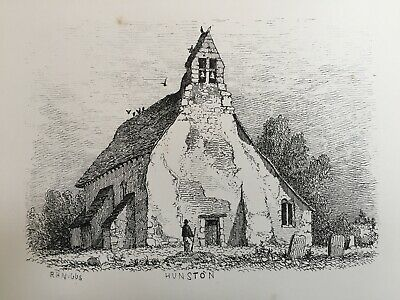
The present Church replaced an old church which had fallen into decay. When visited by Sir William Burrell in 1776, it consisted of a nave, south aisle and chancel. The chancel had been rebuilt by Charles Randell Covert, Rector from 1719 to 1759. A drawing and description in the Gentleman’s Magazine for 1792 shows that it still retained a 12th century south door, with chevron moulding, partly mutilated for a modern porch. The nave roof was carried over the south aisle, which had an arcade of three pointed arches on slender round columns, and a west window of two lancet lights. The west wall had a plain rectangular door, and no window; there were two clumsy modern buttresses against it. The church was then said to be in ‘so decayed a state that its utter ruin seemed unavoidable before long’. This description is supported by that given by Mr RH Nibbs in his book ‘Churches of Sussex’ published in 1851.
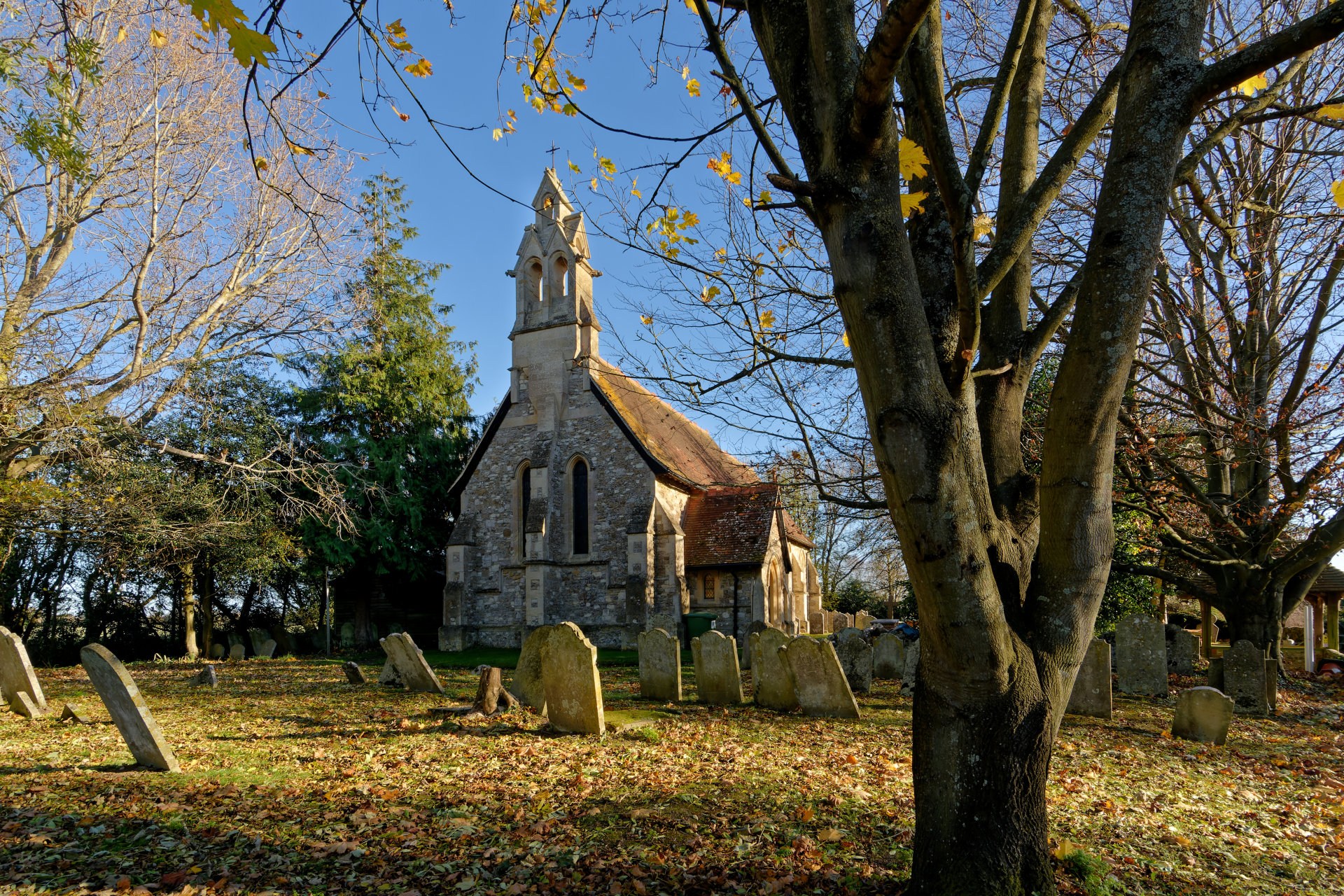
Following a vestry meeting held in February, 1885, the pulling down of the old Church was begun on the 25th March, 1885. The present church was built on the same site and completed within six months in the same year. It was designed in the early English 13th century style by AW Blomfield, a well-known church architect of the time and a specialist in modern Gothic. It was consecrated by Bishop Durnford on the 22nd of October, 1885. The cost was £4,500 and the money was found by the Rector, the Reverend JCB Fletcher, and other members of the Fletcher family.
It is a point of interest that the north wall of the new church is built in the position occupied by the north wall of the old church. As there is now no south aisle, the new church is now narrower than the old and the vaults that were formally on the south side are now outside the church.
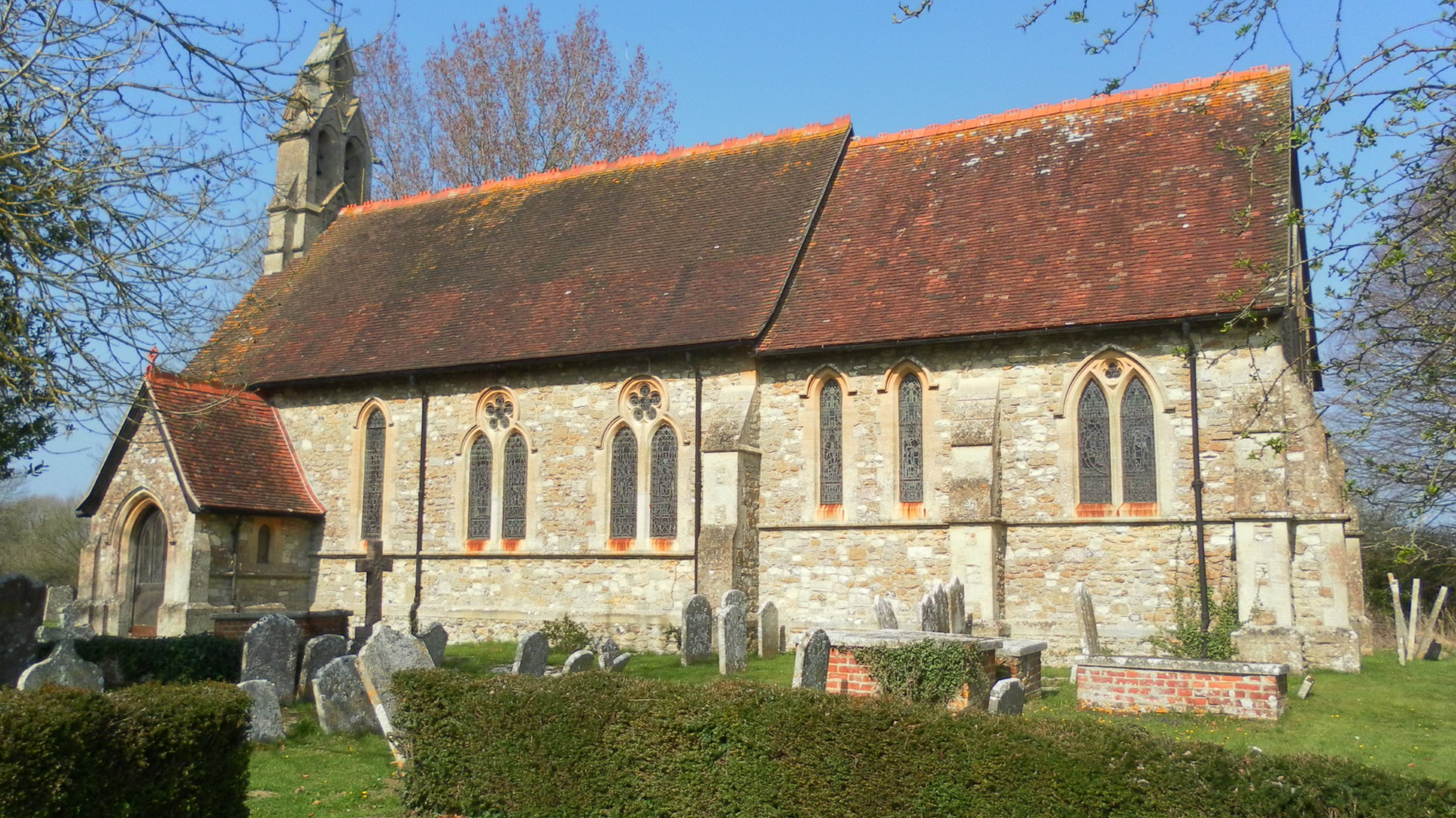
The church is a stone building and holds about 100 worshippers. It consists of the nave, chancel, vestry and south porch. At the west end is a turret containing two bells.
The chancel of arch is very lofty and wide. The Altar is approached from the nave by five steps. Behind it is the rerodos of mosaic, which shows Christ on the cross with Saint Mary and St John on either side, sun and moon darkened and stars falling from heaven. Alpha and Omega are on the outer panels.
The windows are thought to illustrate the Te Deum. Scenes from the life of Jesus are depicted, including the Ascension of the king of glory in the east window. In other windows are representations of Cherubim and Seraphim, the glorious company of the Apostles, the goodly fellowship of the Prophets, the noble army of Martyrs, the Holy church throughout the world. Saint Ambrose and Augustine, the supposed authors of the Te Deum are also there.
It is interesting to note that the architect has preserved much ancient symbolism in this modern church. For example, the three fold east window symbolises the Trinity; the font placed near the entrance of the church reminds us that it is by baptism that one enters the church of Christ; the size of the chancel arch and the open chancel beyond recall to us the destruction of the veil of the Temple and the opening of the way to the Father by Jesus; the five steps to the altar signify his five wounds; the two west windows, His two natures; the four steps to the pulpit refer to the four Gospels; the cross, the sign of the Christian faith, placed on the turret, marks the whole building as the place where Christ is worshipped.
There are one or two odd things in the church. In the floor between the chancel and vestry lies the tombstone of Robert Adams, a Rector of Hunston who died in 1702. Nearby, under the altar-rails, is a small brass plate to John Playstoo, another Rector, who died in 1497. A much later memorial, to members of the Cosens family who lived in the manor opposite, is fixed to the south wall of the church. The piece of carved stone incorporated in the piscena on the south side of the sanctuary, was doubtless taken from a former church.